An essay about Highking Ferigahr Graht I and his coming to Hascrith.
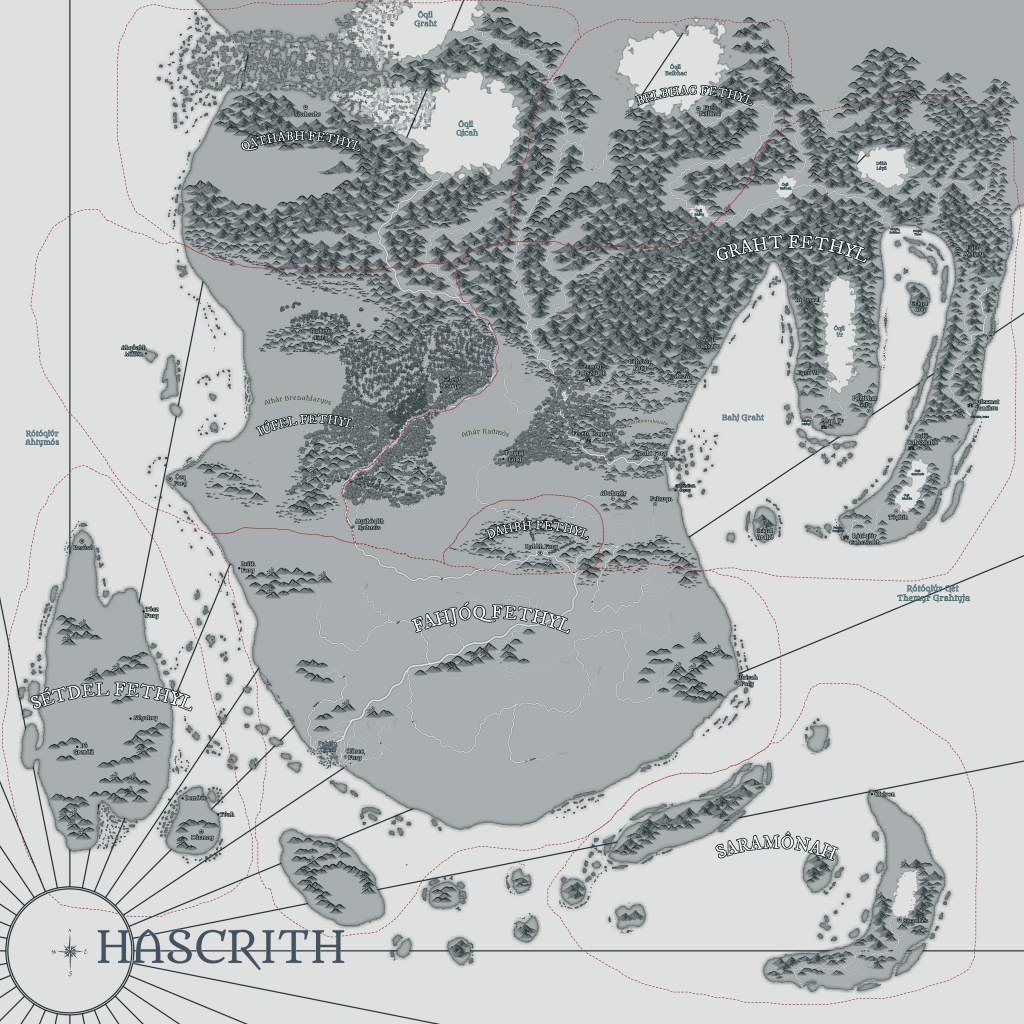
The ore rich peaks of Belbhac Fethyl loom over the North-Eastern reaches of Hascrith showing their vast prominence and wealth within Hascrithian society and wherein live the Glytdérs in their mountaintop castles and forts, sitting upon thrones of bronze with jaspers and diamonds decorating them, while down in the tropical heat and rain forested landscape of Saramônah in the South of Hascrith the people dress in silk and colours and speak with a vibrato in their speech. Spanning the rain soaked and foggy West of Hascrith there exists the temperate climate of Iúfel Fethyl where the people love music and working on dockyards where they love writing legends about sea monsters and fairies, and likewise in the NorthWest where in Qathabh Fethyl you will find a harsh icy desert covered in glaciers and dangerous icy crevasses but people that contrast their environment with their welcoming and warm nature. In the neutral state of Dahbh Fethyl in the centre of Hascrith there may be no naval force but there is an impenetrable maze of meticulously dammed rivers defending a population of arcane scholars and devotees, contrasted by the Southernmost and largest of Hascrith’s Kingships; Fahjóq Fethyl where the ever-changing flow of the hundreds of small rivers and streams make the land boggy and impassable but where the people make the best of all situations good or bad, by holding to their faith in the one God; Ôdiséahn. Off the coast of the main continent to the South-West is a large island known as Sétdel Fethyl that hosts a wealth of sprawling and awe-inspiring meadowlands covered in colourful flowers and speckled here and there with lone trees, the people of Sétdel Fethyl are often a nomadic sort which is a way of life being threatened by one of the contested kings of the Kingship of Sétdel Fethyl, and finally to the East of Hascrith; Graht Fethyl, a land covering in deciduous trees and where sitting upon their throne in Graht Forg lives the Highking or Highqueen of the Graht Dynasty.
Hascrith has three main periods of time to track its calendar by and it is probably best to start at the end. There are three main periods of time in Hascrith, the first of which is ‘The Era of Kings (EK)’ which starts at 1 and ends at the most current day which is ‘Ôdébhôron’, the first day of ‘Ôdôah’, in the year 1,100EK. Before The Era of Kings was ‘The Era of War (EW)’ which marks a period of 10,105 years of near constant war where the rulers of Hascrith changed and rotated and were constantly disputed with the passage of time and history only being recorded by the scholars of Dahbh Fethyl and Saramônah, who the estimate of 10,105 years in The Era of War comes from because of the trade and royal records from the time. Before The Era of War came the time before time, an era that is referred to by scholars as ‘The Forgotten Era (FE)’ due to the limited records and knowledge of the time especially consider the 10,000 year era of pure destruction that has happen since then.
A long time ago, before the Era of Kings and The Union of Hascrithian Kingships, there existed a wild and untamed continent that was at constant war and strife, there were kings and queens declaring their territories and fighting over those territories in every corner of this unnamed continent and amid all of the bloodshed there was no single ruling power that could quell the constant fighting. From the mountainous territories of Belbhac Fethyl in the north to the wet and river soaked lands of Fahjóq Fethyl in the south the land was stained with the blood of soldiers fighting for reign and control over the lands and it was told that within all of this fighting there would be one to unite the entire land, one man or woman with a voice and power strong enough to stop the wars and to bring together a land scarred by an era of ten thousand year of fighting. Whispers and rumours circulated the land, bringing hope and wonder to all about who the prophesised saviour of the then unnamed continent would be, and yet in over ten thousand years of constant war there seemed to be no clear end to the fighting and no clear owner of the title of Themyr Grahtyah, Prophet Royal. As The Era of War raged on and on without an end in sight the story and prophecy of the Themyr Grahtyah began to fade into distant memory until eventually it was entirely forgotten by most until in the most unlikely fashion the Themyr Grahtyah was found by the most unlikely of sources and the Themyr Grahtyah himself was also the most unlikely of people.
Ferigahr set sail from Aborford with a ship full of his fellow escaped slaves, they were brothers and sisters in bondage and they were brothers and sisters in their free states. But where should they go now that they were free and at sea? West, as west as west would go, falling off the edge of the world itself if that was their faith for anything was better than living beneath the thumbs of the oppressive Twylaj Sryqó of the forests of Aborford. This escaped ship consisted of people from every walk of life and of every race in the world but most were Srybhán that were themselves born into slavery whose uprising was an unexpected phenomenon that succeeded by virtue of guerrilla warfare and significant deceptions, and Ferigahr was their leader and mastermind. After years of organising and getting support from his fellow slaves, Ferigahr gave the final call to take up arms against their oppressors and to sink and steal as many boats as possible before sailing west in search of more bountiful lands.
Culturally and geographically distinct from each other, not to mention the wide spread of different races looking to practice, and sometimes, impose traditions upon unwilling others; The Union of Hascrithian Kingships is a tenuous agreement that hinges itself almost entirely on the legitimacy of The Graht Dynasty and their first member, Highking Ferigahr Graht I “The Prophet King”, who died by assassination in the year 6 of the Era of Kings (EK) by a crossbow bolt through the eye while sitting to eat lunch with his beloved wife; Tiljelah Belbhadon, after less than a decade in Hascrith, bringing the union into its infancy and holding it together with his God given prophecy to find a home for his enslaved people and to unite the war torn people of the land, this land that one might say is quite magnificent to behold, and as it is said in The Diary of Highking Ferigahr Graht I
“And look now as this ship lands here in this new world, never before seen or stepped on by me or my people, but now with this remark and message from God above, Ôdiséahn, I have come to this land of savage play where beasts roam free and every man and woman with a stick is a warring King. But look to my north and I see mountains, strong and mighty, and capped with snow, and with forests of oak and hawthorn in their foothills like hair atop the head of the rolling plain leading up to them. And look to my south and I see waves of hills and meadowlands leading up to their own sparse little range of mountains. And in front of me, to the west as I look, there seems another forest like the ones in the foothills to the north but just on the edge of my vision. And I hark to the northern bank of this blood-soaked river, strewn to the banks with the dead of a many century’s long war, and viscerally the carrion beasts of the river and sky come for them, sickening as the sight is to me and my men it is ignored by the man that awaits me upon the northern bank.
‘Lo to you! I travel here with peace in mind and heart!’ I called out to the man.
And his response was a wave of the hand and one word said in my own language with the strongest of guttural, brutish accents, ‘Friend.’”
Despite his verbosity when writing and his portrayal of the natives of Hascrith as beastly people, Ferigahr I was a benevolent and kind Highking who gained the favour of three of the six kingships in The Union of Hascrithian Kingships – those being Graht Fethyl, Belbhac Fethyl, and Iúfel Fethyl – as well as the allegiance of Dahbh Fethyl. Ferigahr Graht I had a younger brother that would be his successor in the event of him being childless upon his death, a faith which dreadfully came to pass. Fendán Graht, younger brother of Ferigahr, was a cunning and gifted strategist and was known to have masterminded a great many of his older brother’s assaults on Hascrithian castles, he was known to have went bravely into battle alongside his troops while his brother sat in a tent discussing politics with his fellow kings and queens, he was known to have been immensely jealous of his older brother which is why he is one of the main suspects in the unsolved murder of Ferigahr Graht I ‘The Prophet King’.
After calling his ‘Friend’ during their first meeting, Ferigahr Graht I and Alfons Bhôrahnys of Dahbh Forg became exactly as the latter suggested, fast and close friends. After a short time they were learning each other’s languages and translating the messages that Ferigahr had received from God. After spending two years in a large camping settlement – or more of a shanty town to be true – by the northern banks of Fahjóq Graht (River Crown), Ferigahr had become fluent in Rôbhá, the old language of the mountain people of Hascrith –from which Alfons Bhôrahnys borrowed the alphabet when he spent his life’s work making the language of Hószcré to be the main language of The Union of Hascrithian Kingships –and was educated in the geography and political landscape of this new land. Soon enough, Bhôrahnys and Graht became names that were inseparable, so much so that it required addressing by the King of Dahbh Fethyl and Alfons Bhôrahnys’s older brother King Dúlahán Bhôrahnys when he swore an allegiance to Ferigahr Graht I, an unlikely and rare – even at that time – event for a Dahbhian leader.
Sitting now in the current day where there is war in Graht Fethyl once again, the oppressive city-state of Imburrel have used a natural disaster in the form of a volcanic eruption to take their opportunity to lay siege to the city as retribution for the death of King Consort Kazpahr Imbryss being taken by none other than his older son and military apprentice Prince Delgradeer Imbryss, which the Prince blames the Interem Highcleric and Former Apprentice of Highcleric Zernon Farl; Artemis Thorwyr of Tymius not only for the death of his father but for the considerable damage done to the city of Imburrel during his departure from the city. With the siege lasting considerably longer than anticipated and the Imburrel force having some kind of unknown power that drives them so resolutely, the Highking runs short of options for what to do about this terrible situation. Allies are scattered all over the continent and the Graht Fethyl naval force are out on exploration missions since before the siege, with all of the chaos and terror of the moment will there be anyone to come to the rescue of Graht Forg and the elderly Highking Férgon ‘The Peaceful’ Graht IV.
The folk tales as we know speak very grimly about the final king of Dahbh Fethyl in that he became suspicious about the corruption of Fendán Graht I following Ferigahr’s demise and mounted numerous investigations, broke off alliances, and even threatening a full scale war against The Graht Dynasty and its allies. After fleeing his castle and country, Dúlahán was eventually found in a hideout in Graht Forg with plans and weapons to kill Fendán Graht I in just the way that Dúlahán believed Fendán had his older brother assassinated, with a long-range crossbow. For this treason Dúlahán was sentenced to death by beheaded, an act which in every retelling of The Tale of Dúlahán’s Downfall is punctuated by the harrowing and foretelling last words of Dúlahán Bhôrahnys as he looked at his younger brother from beneath the headman’s axe, “Unfortunate will your rein be dear Fendán! If you do not pass this sentence yourself! Swing the axe as your brother’d have done, like a true Highking!” And as the headman’s axe cleaved Dúlahán’s head from his body it is said that the head continued to speak and whispered just to Fendán, “Your progeny will know no peace for this.” Or at least this is what Fendán Graht I in a fit of hysteria believed and ordered the head burned and body returned to Dahbh Forg. It is still said by soothsayers and hags alike that Dúlahán did not die that day but instead became a dreaded Dracamyr, a being of ultimate chaos and calamity, and with Dúlahán it is said that he marches, sometimes on horseback and sometimes not, but undeniably without a head. And behind him always comes an army of the spirits and souls of the enemies of Fendán Graht.
Hascrith is home to two independent nations that align themselves in their own ways even so far as not using the term ‘Kingship’ for their nation or ‘King’ for their leaders. One of these nations is Dahbh Fethyl: a segmented and non-religious community of Arcane Mages, skilled sword wielders, and scholars that largely don’t depend on the rest of Hascrith for support but maintains political and trade relations. Though the Graht Dynasty will always refer to Dahbh Fethyl as a ‘Kingship’ and their leader as a ‘King’, they instead use no form of royal tradition in their governance and haven’t had a king or queen since Dúlahán. Dahbh Fethyl actually refers to itself as ‘The Dahbhian Republic’ and elects a new president every eight years by popular vote amongst the people of the Republic. Once, before the Era of Kings and the age of the Graht Dynasty, Dahbh Forg stood as a beacon of strong and resilient civilisation and the strength of collective will-power in the wake of war, genocide, and pure chaos all around them. This, let the scholars not forget was during the period of time when the terrible and fearsome Dúlahán was a Prince and King of Dahbh Fethyl. They protected their borders and studied their scrolls while their magical military defended their uneasy borders and in the most uncanny of circumstances the nation of predominantly Arcane Mages produced a once in a generation Priest in terms of knowledge and magical prowess, his name was Highcleric Alfons Bhôrahnys, Divine Councillor to the first three Highkings under the Graht Dynasty, and he lived most of his life believing that he betrayed his brother for a false king. This relationship between the first Highcleric and the first few Graht Highkings is the shaky foundation laid below the political relations between Dahbh Fethyl and Graht Fethyl where neither side respects the other in terms of traditional titles, acknowledgement of native languages, the legitimacy of royalty and nationhood, as well as a number of other deep-cut issues between an old nation and an ancient nation.
The other of these two nations is Saramônah, a rain forested nation of eccentrics, artists, and magical scholars that manage to prosper so much from their natural produce and fishery businesses that they actually export most of their food resources to the greater mainland of Hascrith. Using the title of Emperor and referring to Sarahmônah as ‘The Sarahmon Empire’, the leader of Saramônah has always been a hereditary title that The Graht Dynasty has not ever attempted to interfere with, in-fact Graht Fethyl and Saramônah are known to have extremely good relations while also withholding large amounts of military power and new magical or holy information, despite cooperating only in trade the relationship between Graht Fethyl and Saramônah remains strong and respectful. In the modern day, the people of Saramônah treasure most of all the arts, and of all kinds as well, they respect poetry and story crafting, dancing and musicianship, painting and sculpting, and all manner of different artistic and peaceful pursuits. However, don’t let this very recent movement towards the arts mislead you, Saramônah is an Empire and it stands by that title playing host to one of the largest and most formidable navies in all of Bhérdón Rés, to quote the great and peaceful Highcleric Zernon ‘The Peaceful’ Farl (Born: 12, Ôdôah, 1019EK. Died: 25, Yrdôah, 1098EK.) “Saramônah builds itself into a cultural hub on the backs of the cultures they desecrated and ravaged without remorse, don’t let the future forget this, an emperor must relinquish his hereditary rights if he expects to be judged without hereditary guilt.”


Leave a comment